An ads clicker bot is software designed to click online ads automatically while passing itself off as a real person. Google lists clicks from automated tools, bots or other deceptive software among its examples of invalid clicks, so a click bot is, by design, a generator of exactly the traffic that ad platforms try to filter out and refuse to bill.
People look for click bots for different reasons: to hurt a competitor, to earn money from ads on their own site, to make numbers look better, or because they believe clicks will lift their rankings. None of those motives holds up against how ad platforms actually work. This article explains, strictly at a conceptual level, what such software tries to do, why it is prohibited, what Google says about detecting it, which kinds of signals tend to expose automated clicking, and how advertisers can monitor and protect their campaigns. It ends with a plain-language warning for anyone thinking of buying one.
Note: This publication does not provide instructions, tools or technical details for building, buying or running click bots. Everything below is descriptive and aimed at recognizing and preventing automated clicking.
What an ads clicker bot is
An ads clicker bot, often shortened to click bot, is a program whose job is to produce clicks on ads that no interested person made. The phrase “google ads clicker bot” usually refers to the same idea aimed at ads served by Google, whether they appear in search results or on publisher websites and apps.
Three features separate click bots from other software that touches ads:
- They are undeclared. Legitimate crawlers, such as the ones ad platforms use to check landing pages, generally identify themselves. A click bot tries to look like an ordinary visitor.
- They target the click. Monitoring tools fetch pages; click bots specifically interact with ads, because the click is what gets billed to an advertiser or paid out to a publisher.
- There is no genuine interest. Whatever the motive, the click does not come from someone who wants the product or service.
Click bots sit inside a much larger landscape of software that interacts with ads. Our overview of automated ad traffic maps benign crawlers, verification tools and malicious automation side by side, while our explainer on the different meanings of “ads clicker” covers the human versions of the same problem, such as paid clickers and click farms.
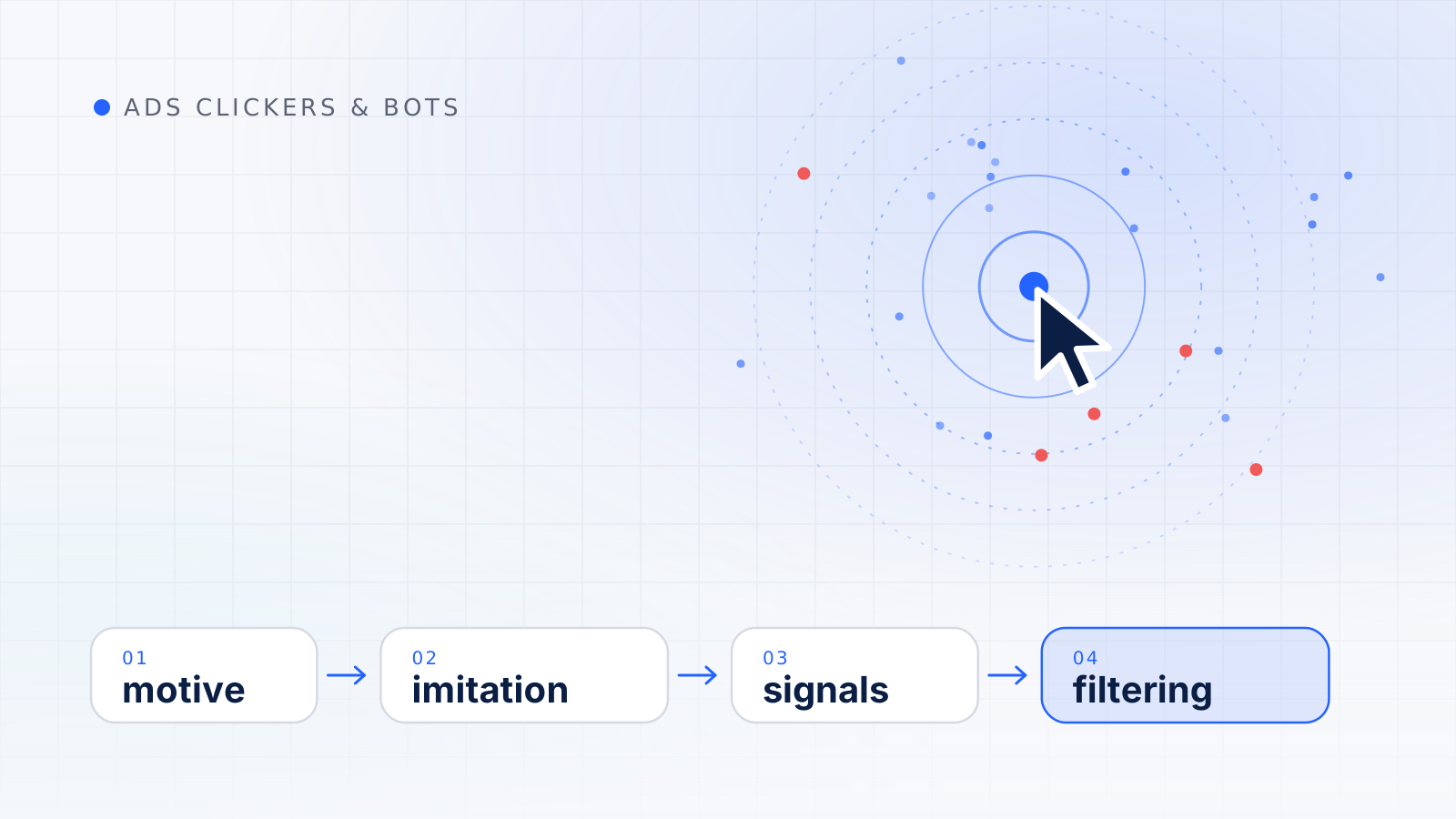
What click bots try to imitate, in concept
A click bot’s basic problem is that ad platforms are actively looking for it. Conceptually, it therefore tries to imitate three things:
- A believable person. It tries to appear to be a real user with an ordinary browser and device, searching or browsing before it clicks.
- A believable crowd. One visitor clicking hundreds of times is easy to spot, so automation tries to look like many unrelated people in many places.
- A believable visit. Because what happens after the click is also observed, it may try to behave like a visitor who lands on a page and looks around.
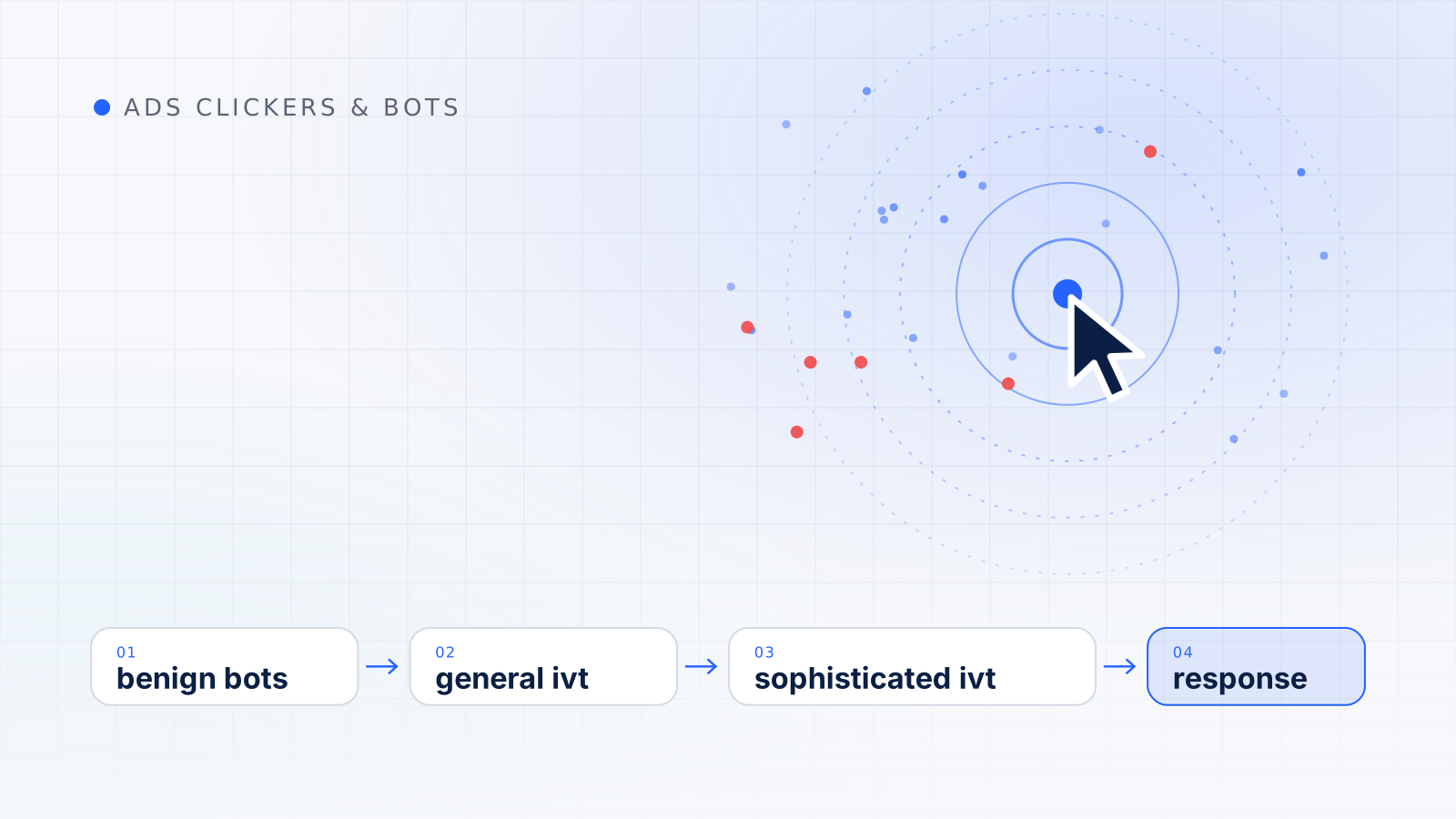
The industry standard for measuring invalid traffic, published by the Media Rating Council (MRC), describes this territory in its list of sophisticated invalid traffic. Its examples include automated browsing from dedicated devices, automated browsing from infected and hijacked devices, and bots and crawlers masquerading as legitimate users. The hijacked-device category is a reminder that some automated traffic runs on real people’s computers or phones without their knowledge, which is one reason it can be hard to separate from genuine activity.
A US federal prosecution shows how far this kind of imitation can go, and how it can end. In November 2021 the US Attorney’s Office for the Eastern District of New York announced that the operator of a scheme known as “Methbot” had been sentenced to 10 years in prison after a jury convicted him of wire fraud conspiracy, wire fraud, money laundering conspiracy and money laundering. According to the press release, the scheme used rented servers in commercial datacenters that were programmed to simulate people viewing ads, and the defendant and his co-conspirators stole more than $7 million from US advertisers, publishers, platforms and others. That case centered on fake ad views rather than clicks on search ads, but the core idea, software pretending to be an audience, is the same.
There is a structural weakness in all of this. The more an automated system tries to imitate people, the more separate details it has to keep consistent with one another, and inconsistency is precisely what detection looks for.
Why people use click bots, and why each motive fails
| Motive |
What the user hopes for |
What actually happens |
| Competitor sabotage |
Drain a rival’s budget so their ads stop showing |
Google names competitor clicking as invalid traffic; detected clicks are not billed, and later detections are credited where appropriate and possible |
| Publisher revenue |
Earn money from ads on one’s own site or app |
AdSense prohibits automated click tools; invalid clicks can reduce finalized earnings, and accounts can be limited, suspended or closed |
| Inflated metrics |
Make a campaign, placement or website look more popular |
Detected invalid activity is removed from campaign metrics, and whatever slips through corrupts the data used for decisions |
| Rankings |
Push a site higher in search results |
Google says running ads has no impact on organic placement |
Competitor sabotage
Google includes competitors who manually click to increase your spend in its examples of invalid traffic, alongside non-human traffic from bots and automated software. It says it removes invalid traffic detected before the end of the billing cycle from the advertiser’s metrics and billing, and credits invalid activity found later where appropriate and possible. A saboteur can therefore take on effort and risk without causing the intended damage. Our article on Google Ads click fraud and how to report it looks at this motive in more detail.
Publisher revenue
For publishers the rules are blunt. AdSense policy states that any method that artificially generates clicks or impressions on your Google ads is strictly prohibited and names automated click and impression generating tools, robots and deceptive software among the prohibited methods. Google’s AdSense help also notes that invalid clicks can cause a difference between estimated and finalized earnings, so inflated clicks do not reliably turn into money even before any action is taken against the account.
Inflated metrics
Sometimes the goal is appearances rather than direct payment: a campaign that looks busy, a website that looks valuable to a prospective buyer, or a placement that seems to perform. When Google’s automated protections determine that clicks are invalid, those interactions are filtered out of campaign metrics and removed from billing, so the inflation may not even survive in ad reports. Whatever does get through still pollutes analytics and conversion data, which makes every decision built on those numbers worse.
Rankings
A persistent myth holds that clicks signal popularity and push a site up the rankings. Google’s help center addresses the advertising side directly: running online ads has no impact on where your website appears in organic search results. Generating fake ad clicks to influence rankings adds policy risk with no documented benefit.
Policy, account and legal risks
Risks for publishers
AdSense policy reserves Google’s right to disable ad serving to a site or disable an AdSense account for publishers who do not comply, and it states that a publisher whose account is disabled is no longer eligible to take part in the program. Google’s AdSense guidance on invalid traffic adds that high levels of invalid traffic can lead Google to suspend or close an account, and that if it cannot verify the quality of a publisher’s traffic it may limit or disable ad serving. It also makes a point many publishers overlook: even when a third party generates invalid traffic without the publisher’s knowledge, it is ultimately the publisher’s responsibility to ensure that the traffic on their ads is valid.
Risks for advertisers and individuals
For anyone pointing a bot at someone else’s ads, the first risk is simply wasted effort, because detected clicks are filtered. Beyond that, deliberately generating fraudulent ad activity can carry legal consequences. The Methbot case described above ended with a 10-year federal prison sentence and, according to the Justice Department’s announcement, an order to pay $3,827,493 in forfeiture. Laws differ between countries and this article is not legal advice, but treating automated ad clicking as a harmless prank is a serious misjudgment.
Risks to your own data
Even a small experiment with a click bot contaminates your own analytics, attribution and bidding data with sessions that represent nobody. Cleaning that up afterward is far harder than never introducing it.
What Google says about detecting a Google Ads clicker bot
Google does not publish its detection methods in detail, and it explains why: detection methods and specific invalid traffic sources remain confidential so that bad actors cannot reverse-engineer its defenses. What it does describe publicly is a layered system:
- Automated filters. Google’s Ad Traffic Quality site says it uses filters to stop the vast majority of invalid traffic in real time or soon after.
- Longer-term analysis. Some invalid traffic takes more time to confirm. The same page says that in some cases it may take up to several weeks to recognize a suspicious pattern, and Google Ads Help notes that Google also analyzes traffic over longer time periods to find more complex patterns.
- Manual review. Because no filter is perfect, Google says it also manually reviews issues flagged by advertisers, publishers and its automated systems, and uses what it learns about new threats such as botnets to improve its filters.
- Billing protection. Clicks found invalid are removed from metrics and billing, and invalid activity detected after an invoice is credited on a later invoice where appropriate and possible.
The industry standard helps explain why some invalid activity is only removed later. The MRC notes that detection procedures for sophisticated invalid traffic may take time to execute and may not be feasible to apply in real time, and that such traffic is likely to be removed downstream, at a later stage, partly to protect detection methods from reverse engineering. For an advertiser, this means some invalid activity shows up as a credit rather than as a filtered click.
Signals that tend to expose automated clicking
Detection relies on combining many weak signals rather than on a single giveaway. Without going into thresholds or specific techniques, the relevant signals fall into four broad categories. Several of them correspond to routine checks that the MRC standard requires of accredited measurement organizations, such as filtering known invalid data-center traffic, identifying non-browser user agents, and activity-based analysis of the speed and repetition of transactions.
| Category |
What reviewers consider |
Why it is informative |
| Origin |
Where traffic appears to come from, for example known data-center networks rather than consumer connections |
Most people browse from homes, offices and mobile networks, not from server farms |
| Consistency |
Whether the claimed browser, device, location and behavior fit together |
Imitation has to keep many details aligned, and mismatches accumulate |
| Timing |
The speed and repetition of actions, the intervals between them and clustering in time |
Human activity is irregular in ways that are hard to reproduce at scale |
| Behavior after the click |
Whether visits engage with the landing page the way people normally do |
Clicks that never become meaningful visits stand out against normal traffic |
None of these categories is proof on its own. Shared office networks, privacy tools and impatient visitors all produce some of the same patterns, which is why platforms combine signals and why advertisers should do the same before drawing conclusions.
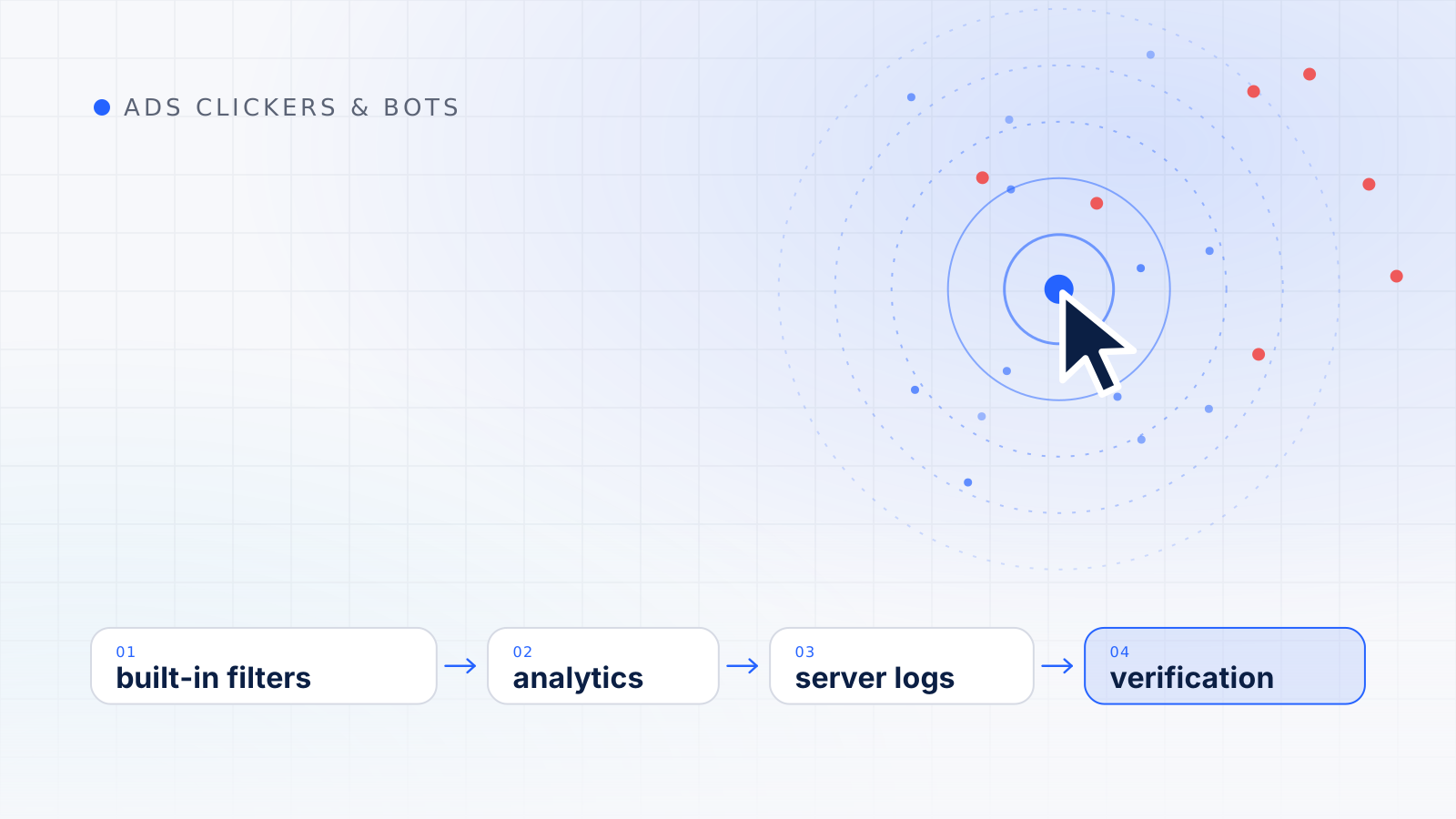
On your own website, these signals show up in analytics and server logs rather than in Google Ads reports. Our guide to bot traffic detection explains how to look for them responsibly, including how to verify legitimate crawlers so you do not mistake them for attackers. Mobile apps raise their own variations, covered in our guide to mobile ad traffic quality.
Monitoring and protecting your campaigns
You cannot stop someone from pointing a click bot at your ads, but you can make sure you see what is happening and that you are not paying for it. Google’s help page about invalid traffic describes most of the tools involved:
- Add the Invalid clicks column. It shows how many clicks Google’s automated protections filtered. Rising numbers there mean filtering is working, not that you were charged.
- Check credits. Invalid activity found after billing appears as an “Invalid activity” adjustment in your billing summary. Our guide to Google Ads invalid clicks and credits explains where to find both.
- Compare with your own data. Review sessions, engagement and conversions by campaign, device, location and hour, and set them against clicks for the same segments.
- Protect your forms. Google notes that its filters run after an ad serves and cannot stop invalid traffic from reaching your site, and it recommends reCAPTCHA and server-side validation for lead forms.
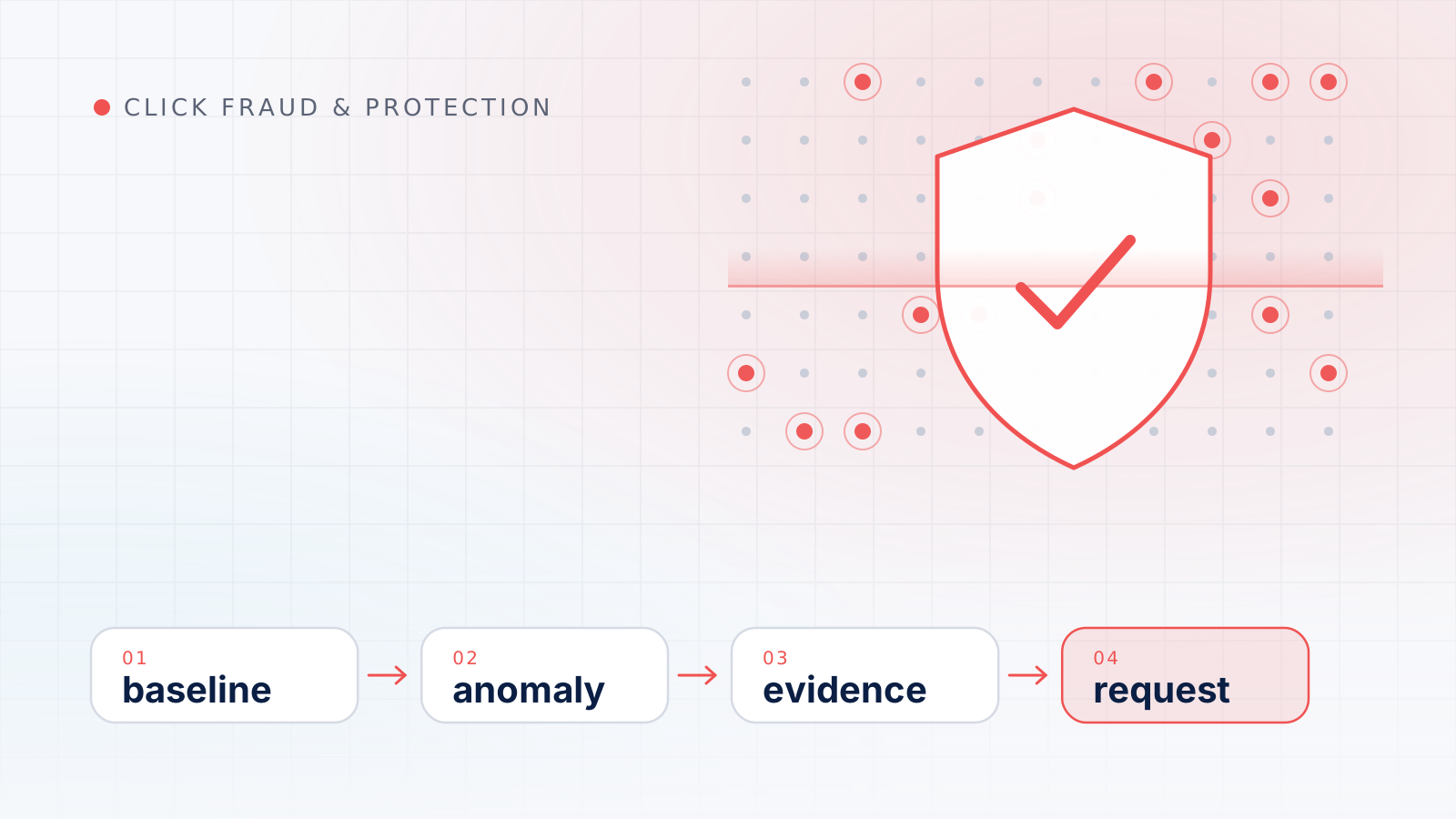
- Build evidence before acting. If something looks wrong, document it carefully and avoid accusations. Our method for detecting click fraud with evidence shows how to build a case.
- Use the controls you have. Exclusions, targeting settings and network choices all limit exposure; see our guide to practical invalid click protection.
- Request an investigation if needed. Google accepts investigation requests for activity within the last 60 days and suggests including details such as web server logs.
Thinking about buying a click bot? Read this first
If you found this page because you are considering a click bot or a “click service,” here is the plain version:
- It is prohibited. Google treats clicks from automated tools as invalid, and AdSense names automated click tools explicitly as a prohibited method.
- It largely does not work. Google filters invalid clicks and credits advertisers for invalid activity it finds later, so a competitor may never pay for the clicks you buy, and a publisher may never be paid for them.
- It can cost you your account. Publishers can lose ad serving or their AdSense account, and responsibility applies even when someone else sent the traffic.
- It can be a crime. Large-scale ad fraud has led to federal prosecution and a prison sentence in the United States.
- You cannot verify what you are buying. Software sold for breaking platform rules comes from sellers who are willing to break rules. You have no reliable way to know what else it does on your devices or with your data.
- It damages your own data. Every fake click becomes noise in the analytics and bidding data you depend on.
If your real goal is to see how your ads look, to understand why performance changed, or to protect your budget, each of those has a legitimate route, and the guides linked throughout this article are a good place to start.
Key takeaways
- An ads clicker bot is software that clicks ads while posing as real visitors, and Google classifies clicks from automated tools and bots as invalid.
- Each common motive, from sabotage to publisher revenue to rankings, runs into filtering, credits, policy enforcement or plain ineffectiveness.
- Google describes layered detection that combines automated filters, longer-term analysis and manual review, and it keeps the specifics confidential.
- Signals of automation relate to origin, consistency, timing and post-click behavior, and they are only meaningful in combination.
- Using or buying click bots risks account closure and, at scale, criminal prosecution, while offering nothing a legitimate advertiser or publisher needs.